Help before, during and after an incident
Our CSIRT portfolio is divided into four areas: readiness and prevention, monitoring and intelligence, detection and assessment, and response and recovery. Customers can therefore address gaps continuously instead of waiting for an incident to expose them.
How customers benefit from CSIRT Services
Using CSIRT services proactively helps organizations strengthen their resilience and makes cybersecurity investments easier to prioritize and justify.
- Reduce incident likelihood: Address weaknesses, exposed data, and suspicious activity before they develop into disruptive events.
- Gain earlier visibility: Detect external exposure, third-party leaks, and hidden threats that existing controls may miss.
- Improve operational readiness: Validate plans, responsibilities, escalation paths, telemetry, and response procedures before a crisis.
- Prioritize security investments: Use evidence-based findings and recommendations to focus budgets on the risks with the greatest business impact.
- Reduce financial and regulatory risk: Reduce potential downtime, recovery costs, compliance consequences, and reputational damage.
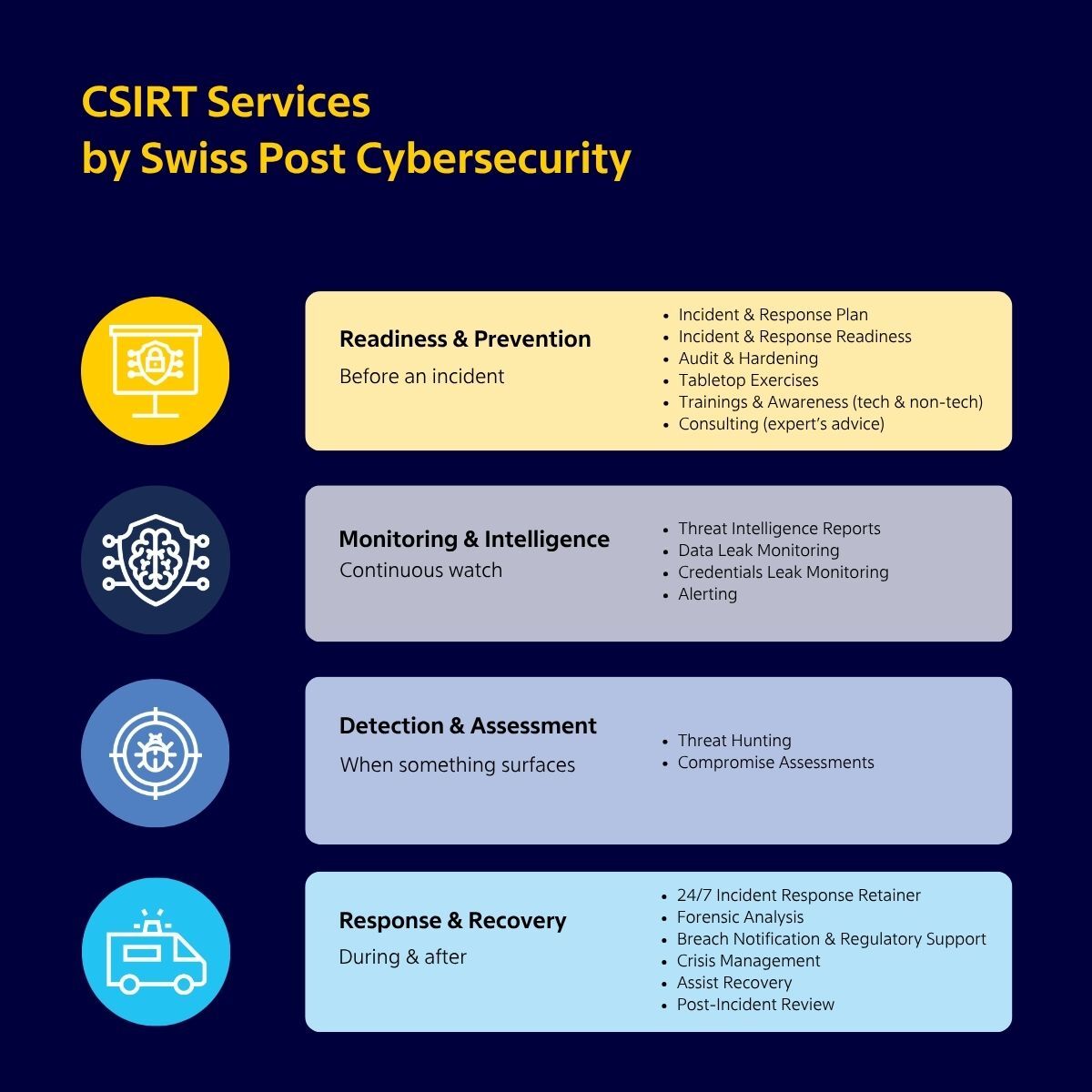
Five examples from our CSIRT portfolio, as shown above:
Tabletop Exercises: Test plans before pressure does
A realistic cyber incident simulation reveals gaps in crisis management, incident handling, responsibilities, escalation paths, and operational practices. CSIRT experts build a scenario aligned with the customer environment, facilitate the exercise, provide immediate feedback, and deliver recommendations. Teams learn to coordinate under pressure, while executives gain tangible proof of readiness – and a prioritized basis for funding improvements.
Threat Intelligence Reports: Turn exposure into priorities
Whether for compliance requirements or internal research, threat intelligence has become essential. By offering two types of reports, Swiss Post Cybersecurity provides both sector-wide coverage and tailored insights, addressing general risk exposure as well as risks specific to your organization. These reports enable you to take concrete actions to reduce risk by improving your understanding of your own exposure, along with the threat landscape affecting your industry and geographic region. And it gives decision-makers evidence for where investment is most urgent.
Data Leak Monitoring: Control your dark web risks
Stolen data may surface on the dark web, deep web, Telegram, Discord, or marketplaces outside your monitoring stack. The service watches for exposure affecting both your organization and selected providers, validates relevant findings, alerts your team, and – when available – retrieves the compromised data securely. Earlier visibility supports faster containment, third-party risk management, and informed legal or compliance action.
Threat Hunting: Uncover hidden threats before they strike
Threat hunting involves formulating a hypothesis about a potential compromise and actively searching for related activities. Even if the results do not always directly confirm the initial hypothesis, the process helps determine whether sufficient data is available to properly investigate a potential incident. Aspects such as log configuration, centralization, field selection, and retention policies are all assessed, documented, and reported to support continuous improvement.
Incident Response Retainer: Help when it matters most
An Incident Response Retainer, based on a clear CSIRT SLA, guarantees rapid access to experienced professionals when a cyber emergency hits. Defined response times ensure that you can access help when you need it most. It covers two complementary roles: an Incident Commander who owns the coordination, stakeholder management, and communication, and a Technical Responder who analyzes the incident, scopes the compromise, and advises on containment and remediation. Together they ensure both the strategic and technical sides of the response are covered from the moment an incident is declared. reducing delay, ambiguity, and the cost of unmanaged escalation.
Invest before an incident sets the agenda
The above mentioned services make the CSIRT a prevention partner, not only an emergency contact. By combining better visibility, operational support, proactive detection, and response readiness, organizations can reduce the likelihood that suspicious activity becomes a business-disrupting incident.
For CISOs and IT leaders, the investment case is practical: prevention costs less than downtime, investigation under pressure, regulatory consequences, and reputational damage.